
Contact the NSPCC Helpline
You can contact our Helpline by calling 0808 800 5000 between 10am and 4pm, Monday to Friday, or by emailing [email protected] between 11am and 4pm, seven days a week. If you send an email when the service is closed, it won't be received, and we won't know that you've tried to get in touch.
If we have not yet responded to you and your concerns for the safety of a child increase, please contact the police or local Children’s Services directly. Please be assured that we'll action all contacts that our Helpline receives.

Under 18?
Childline offers free, confidential advice and support whatever your worry, whenever you need help.
Martial arts and combat sports

Asking a few questions when your child is taking part in martial arts or combat sports will help you understand how it will run. You and your child can then focus on having fun, taking part and competing.
How can you check martial arts clubs?
The Safeguarding Code in Martial Arts was created to help you search for martial arts clubs that can demonstrate high quality practices and are suitable for children or adults.
Funded by the National Lottery, this code was launched in 2018 and is delivered through a group of partners, including NSPCC Sport.
 The code supports martial arts clubs, and where high quality safeguarding practice have been shown, the club is able to display the Safeguarding Code in Martial Arts logo.
This should not be taken as a guarantee that a club is safe and parents or carers should make their own judgement. It doesn't include combat sports.
What you should know about combat sport competitions
Competitions are an integral part of sport, whether they are just for fun, or part of a talent pathway to elite-level careers. All competitions are organised differently and they take place locally, nationally and internationally.
If the sport has a high risk of serious injury, head injury or concussion (including martial arts, rugby, trampolining, horse riding or other contact sports), you should feel confident that the organisers are doing all they can to protect your child from harm whilst taking part.
A good club or competition organiser will be happy to answer your questions and provide you with documents.
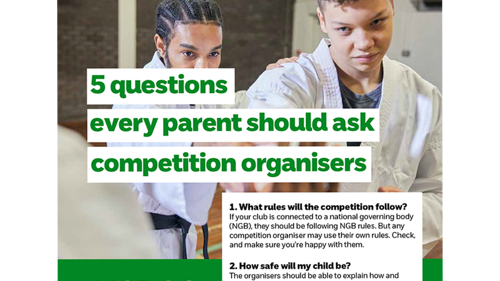
5 questions to ask before combat sport competitions
These questions will help you to know what the organisers are doing to help keep your child safe while taking part. These also feature on a poster that you can download and share with your sport club and other parents and carers.
If the organisation is connected to a national governing body (NGB), they should follow their NGB's rules. But any competition organiser may use their own rules.
Check what the rules are and make sure you’re happy with them. If you’re not happy, it’s OK to withdraw your child from the competition.
The organisers should be able to explain how and who will keep your child safe, including:
- who is first-aid trained and where they’ll be during the competition
- if there will be enhanced medical provision on site (this could be an ambulance with qualified paramedics)
- what happens in an emergency or if a child is injured
- who handles the safety of the event
- who to speak to if you have any worries
All adult staff and volunteers should understand the rules, be aware of head injury, and signs and symptoms of concussion. They should know how to respond and confidently manage the competition.
All staff and volunteers should have received appropriate training for their roles.
The organisers should confirm the protective clothing and equipment children must wear for competitions.
They should provide clear information about the rules and quality of such clothing and equipment to help reduce injuries.
Ask how children are grouped, is this by age, weight or skill level?
Make sure it’s fair and safe. If there are mixed ages or abilities, the physical safety of any young person may be put at risk when engaging in the activity with older (probably larger) competitors.
If you have any concerns, talk to the safeguarding lead.
What should competition organisers have in place?
Event and competition organisers should have the following in place:
- a pre-competition risk assessment and management plan
- a safeguarding plan, which includes health and safety and medical coverage
- a lead person with safeguarding responsibility - this person’s contact details should be shared with all staff, volunteers, children and parents and carers
- safeguarding policies and procedures, which should include:
- correct supervision ratios - the number of adults needed to supervise, based on the young people ages and group size
- photography and filming procedures – so that everyone is clear who can and can’t take and share images and videos
- code of conduct – everyone should be clear what behaviour is expected of them at the competition (including the spectators)
- a process for responding to and managing safeguarding concerns or incidents
- a process for responding to and managing injuries or illnesses – including medical emergencies
- essential competition information, which is to be shared with children, parents and carers
All of the above are covered and detailed in our sports events, activities and competitions guidance for sports organisations.
Key things to consider
If you’re not happy with any answer, ask for more information or consider whether your child should enter the competition.
You can also contact the national governing body for your sport (NGB) or the NSPCC Helpline on 0808 800 5000 or by emailing [email protected] for further advice and information.
Getting ready for a sport competition can be hectic and exciting, so here are just a few practical things to remember to help keep your child safe.
- update your parental consent for children to take part, receive medical treatment if necessary and photography and filming consent
- update your child’s medical and emergency contact information with the club or activity
- confirm travel and transport arrangements to and from competitions, including who will be transporting your child and how long the journey will take, and check your child is comfortable with the plans
- if the competition is an away day trip, or there are overnight trips or international travel, what safeguards are in place?
- read the competition code of conduct so everyone knows what behaviour is expected of them
- talk to the competition organiser and club if your child becomes unwell or has suffered a recent injury – should they still take part?
After your child has taken part in a combat sport competition, there are some things that you can do to help them recover and celebrate.
Post-combat recovery. Ask the club or competition organiser for guidance on what to look out for if your child has sustained any injuries, especially head injuries or concussion. They should be able to give you advice, including on when your child can return to training.
Praise effort and progress, not just performance. Regardless of the outcome, praise effort and progress not just the result. Read our tips on negotiating the post-game conversation to support your child during and after losses or wins.
Raise any concerns or worries as soon as possible with the competition organiser and or your child’s sports club.
You might also like

We all want children and young people to enjoy taking part in sport – and parents play a key role in that. Find out what else you can do.